RAILWAY TRACK GAUGE IN SOUTH AFRICA
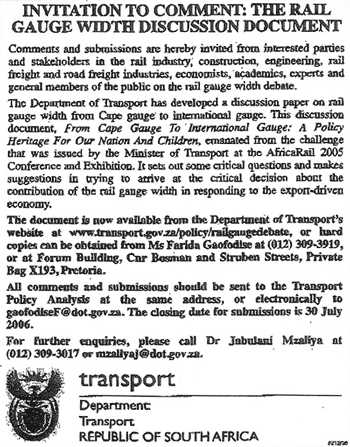
The following advertisement
appeared in The Sowetan on 9 July 2006:
Railway Corporate Strategy
CC responded as follows on 28 July 2006:
“The Department of Transport is to be complimented on, and encouraged
in, its quest to resolve South Africa ’s gnawing railway gauge issue.
While the Policy Discussion Document itself aggregates a disparate
assortment of aspirations and aspersions, facts and fiction,
information and disinformation, above all it puts forward an objective
to which railway stakeholders of all persuasions in South Africa can
unreservedly commit.
After due consideration, it was therefore considered wise to offer a few high-level comments only at this time.
The abovementioned disparate assortment is bound to harbour many
partisan positions. In the inescapable interaction to align all railway
stakeholders within a consensus outcome, like rocks in a river, some
positions will be eliminated, while others will emerge as well-rounded
stones. Item-by-item commentary by individual stakeholders at this time
can thus represent no more than posturing: At present it is more urgent
to engage all stakeholders in seeking that consensus outcome and moving
toward it.
Most railways in South Africa are in poor shape. Many of their assets
are fully depreciated and/or worn out, and will need to be renewed or
withdrawn before long. The cost of changing track gauge will therefore
be significantly less than that if sound assets had to be replaced. The
time to initiate a major railway repositioning intervention has thus
never been more opportune than the present.
It is important to appreciate that track gauge is not the only reason
for current railway under-performance in South Africa . It is only one
of many reasons, of which some are peculiar to South Africa , and
others are shared by constrained railways around the world.
Globalization has profoundly affected the railway industry: In many
respects its members are playing out a global endgame—those that adapt
successfully now will prosper into the future, and those that pass up
an opportunity to adapt now will find themselves drifting beyond
redemption.
South Africa is not alone in its railway predicament. Many other
ex-colonial railways face similar watershed decisions. The way forward
lies in letting railways be the best they can be by leveraging their
genetic technologies: One of the most critical steps is successfully
addressing the track gauge issue. The Department’s readiness to
entertain all shades of opinion on the matter will ease the rapids of
adaptation that lie ahead.
As urged by Minister Jeff Radebe, Railway Corporate Strategy CC is
willing to engage government. RCS is a globally-unique, research-based,
consultancy. Its establishment was triggered by the looming question of
railway sustainability, which has been perceptible to the keen railway
observer in South Africa since the mid 1980s. In recent years, it has
developed an intellectual toolset with which to examine and report on
fundamental railway positioning questions within a global context. By
way of example, an RCS paper presented at the recent World Congress on
Railway Research in Montréal is attached.
Railway Corporate Strategy CC therefore requests an opportunity to make
a presentation to the Department of Transport on the opportunities and
pitfalls of railway globalization. Furthermore, it is willing to audit
the status quo in South Africa with respect to global railway drivers,
and to advise on various options for overall railway repositioning
regarding track gauge as well as other necessary major interventions.
Thank you for the opportunity to comment. Railway
Corporate Strategy looks forward to a positive response to this letter,
and to a constructive relationship en route to sustainable railways in
South Africa .”
2
August 2006
|